


Your shopping cart is empty!
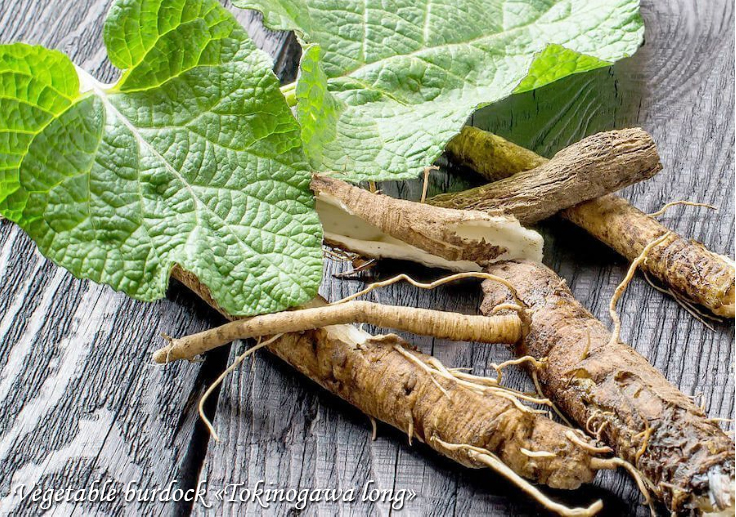
Burdock "Tokinogawa Long"
Eco seeds
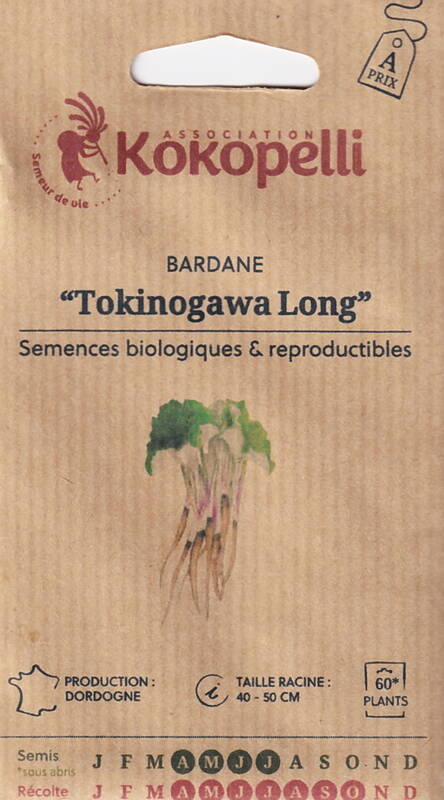
Great Burdock "Tokinogawa Long" (Gobo) - Arctium lappa = Lappa major Gaertn.
For the treatment of kidney diseases, gallbladder and joint ailments. Very beneficial for diabetics.
Family: Asteraceae. A biennial herbaceous plant with a branched taproot. In the first year of life, it produces a juicy root (root vegetable) and a rosette of leaves. In the second year, the plant blooms, forming a branched shoot 60-80 cm high. The weight of the root vegetable is 200-600 g.
Vegetable burdock is cultivated for its roots and young leaves, which are used in cooking and as a medicine. Burdock roots contain the polysaccharide inulin, a large amount of iron, and other active substances. By infusing them in olive oil, burdock oil is obtained.
Agrotechnics (Cultivation).
Previously, the bed is deeply dug, and rotted manure and wood ash are added. On heavy soil, it is necessary to add river sand and well-aerated peat.
Sowing is carried out directly into the ground to a depth of 1-2 cm according to the scheme 40x60 cm, in two terms in spring - in April-May, or before winter - in late October.
Until the shoots appear, the soil must be kept moist. Until the leaves reach a height of 20 cm, the bed is weeded several times, and then the plant suppresses all weeds itself.
Care consists of weeding and loosening the soil.
Harvesting roots in the 1st year of vegetation: September - October.
Sowing in covered ground: April-May or before winter.
Transplanting seedlings: October.
Planting scheme: 40-60 cm.
Harvesting: September - October.
For the treatment of kidney diseases, gallbladder and joint ailments. Very beneficial for diabetics.
Family: Asteraceae. A biennial herbaceous plant with a branched taproot. In the first year of life, it produces a juicy root (root vegetable) and a rosette of leaves. In the second year, the plant blooms, forming a branched shoot 60-80 cm high. The weight of the root vegetable is 200-600 g.
Vegetable burdock is cultivated for its roots and young leaves, which are used in cooking and as a medicine. Burdock roots contain the polysaccharide inulin, a large amount of iron, and other active substances. By infusing them in olive oil, burdock oil is obtained.
Agrotechnics (Cultivation).
Previously, the bed is deeply dug, and rotted manure and wood ash are added. On heavy soil, it is necessary to add river sand and well-aerated peat.
Sowing is carried out directly into the ground to a depth of 1-2 cm according to the scheme 40x60 cm, in two terms in spring - in April-May, or before winter - in late October.
Until the shoots appear, the soil must be kept moist. Until the leaves reach a height of 20 cm, the bed is weeded several times, and then the plant suppresses all weeds itself.
Care consists of weeding and loosening the soil.
Harvesting roots in the 1st year of vegetation: September - October.
Sowing in covered ground: April-May or before winter.
Transplanting seedlings: October.
Planting scheme: 40-60 cm.
Harvesting: September - October.
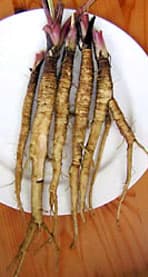
* As a valuable plant, vegetable burdock is widely cultivated in the USA, France, China, and Japan. In culture, it is grown on moist soils via seedlings or by sowing seeds into the ground. At the same time, root vegetables, young leaves, and petioles of vegetable burdock are used for food. The flesh of burdock roots is grayish-white, juicy, sweetish, and pleasant to the taste. They can replace parsnip, parsley, and even... carrots.
The most famous of them is the Russian variety of vegetable burdock "Samurai".
In the first year, this plant forms a powerful rosette of leaves and a juicy root of almost cylindrical shape, branched in the lower part.
It looks like a large carrot 30-35 cm long, up to 5 cm in diameter, and weighing up to 500-600 g, covered with dark gray bark, with white and dense flesh.
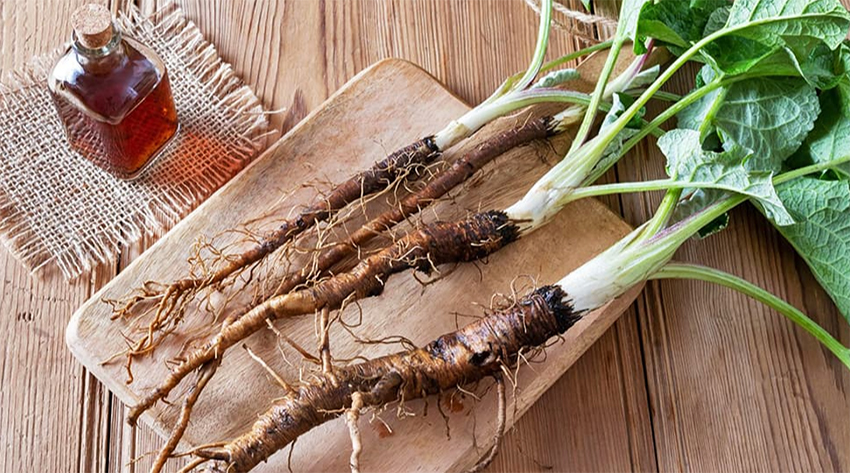
* Vegetable burdock, including wild ones, is exceptionally useful in home cooking.
It is cultivated for its tender salad leaves, petioles, and sweet roots. They will be tastiest in the first year if harvested in late September together with late carrots.
If you leave some plants for spring, they must be harvested before the flower stalks extend, no later than the end of May. A few roots can be left for seeds if there are no wild relatives nearby.
Salads are made from young burdock leaves. For salad or vinaigrette, boiled sweet roots and peeled, boiled petioles are used. Fresh leaves and petioles are added to green cabbage soup. Fried or baked burdock roots are especially tasty.
To make coffee, burdock roots need to be crushed, dried, roasted in the oven until browned, and ground in a coffee grinder. To prepare the drink, put 2 teaspoons of powder and sugar to taste in 1 cup of boiling water.
From burdock roots, you can make jam without... sugar. To prepare it, pour acetic essence into water, bring to a boil. Then lower the burdock roots chopped in a meat grinder into boiling water and cook for 2 hours. Both from leaves and roots of burdock, you can prepare excellent preserves for the winter.
Both roots and leaves of burdock have a rich chemical composition. Young burdock leaves contain up to 300 mg% of vitamin C, which is 6 times more than in the lemon revered by all, and as much as the vegetable champion contains – sweet pepper, and many, many times more than in beets, potatoes, carrots, zucchini, and other vegetables.
And burdock root vegetables contain a large amount of the polysaccharide inulin (more than 35%), which determines the sweetish taste of the root. Inulin in the human intestine breaks down into fructose molecules, which are completely safe for patients with diabetes mellitus.
For medicinal purposes, roots of first-year plants are used when they are juicy and fleshy. Both fresh leaves and dry leaves soaked in warm water have strong antibacterial properties. They are used as a wound-healing agent applied to burns, wounds, cuts, abrasions, inflammations, and swollen areas of the skin.
BURDOCK (ARCTIUM).
You are undoubtedly familiar with this representative of the Asteraceae family since childhood: who hasn't thrown burdock flower heads and untangled them from hair and clothes?..
It is precisely by their basket-inflorescences, in which the outer leaves are subulate-pointed and with hooks at the ends, that burdocks are easily recognized in nature.
The purpose of the hooks is dispersal. Thanks to the hooks, the wrappers get heavily entangled in fur and easily stick to clothes; for greater grip, the wrapper leaves are spread out in different directions. (By the way, these hooks served as a model for people to create "Velcro" fasteners).
About 20 species of burdocks are distributed throughout Eurasia (the origin of the genus is defined as Mediterranean). Six species of this genus are found in Russia, but they differ from each other insignificantly (plant size, size and pubescence of baskets, structure and shape of wrapper leaves). Therefore, burdocks are almost never identified by species by the population and are used indiscriminately, especially since non-flowering plants are almost indistinguishable.
Thanks to tenacious fruits, burdocks settled along roads, paths, on pastures, and in all other places where there is someone to cling to.
The only exception is the wood burdock (Arctium nemorosum), which grows in forests, mainly broad-leaved ones, but even there it chooses edges, clearings, and ravines.
The largest baskets are found in the broad-scaled burdock found in the Caucasus (Arctium platylepis); their core is about 3 cm in diameter, i.e., the size of the entire basket of our common burdock, and taking into account the spines, the diameter of the baskets is more than 5 cm.
By the way, the name "basket" is especially suitable for burdocks. Although all burdocks have tufts on the seeds, they serve only for "decoration".
If dandelion seeds fly well on their tufts, then the heavy large seeds of burdocks cannot fly. This is where the basket works: in damp weather it is closed, and inside, neatly packed, lie the seeds, like pies in a real basket. Bristles on the tops of the seeds prevent them from spilling out of the basket simultaneously, so when the burr clings to a dog's tail, the seeds will spill out gradually. This is how animals and people carry baskets with seeds with them.
Take a closer look at burdock thickets. Even in the densest of them, plants are still located at a distance of 1-1.5 m from each other. For such care, albeit involuntary, burdocks pay generously to those who know how to use them. Of course, this does not negate the fact that, generally, burdocks are rather unwelcome guests on our plots - they occupy a lot of space and heavily deplete the soil.
Burdocks are biennial plants; in the first year, they produce a rosette of leaves, in the second they bloom, bear fruit, and die. They absorb so many nutrients from the soil, especially potassium salts, that potash, used in households as an alkali, for example for washing, was burned from dry burdock stems. And as a fertilizer, especially for acidic soils, burdock ash is very useful.
Under the huge rough leaves of burdocks, there is always shade. Under them, all other weeds die, perhaps nettles survive, but even they bypass the burdock on all sides without approaching the stem. In the shade of large leaves, it is damp and warm; all kinds of small animals settle there - mice, frogs, toads. If you do not have frogs and toads, then the burdock bush will become a shelter for numerous snails and slugs, which greatly harm garden crops by eating leaves and fruits.
In woolly burdock (Arctium tomentosum), the baskets are covered with cobwebby hairs, as if spiders had settled on them, and the stems entirely and leaves from below have felt pubescence. Its roots, young stems, and young leaves are boiled and fried as a vegetable or used to make soups. But the roots of this plant are more bitter than those of the great burdock, and dishes made from them may taste bitter.
Great burdock (Arctium lappa), which, in fact, botanists call burdock, is found in Estonia less often than the woolly one, and lesser burdock (Arctium minor) with baskets 1.5-2 cm in diameter - even more rarely.
A large amount of inulin in burdock roots allows it to be used to obtain sugar. True, the sugar will turn out not quite familiar to us, but fruit sugar.
Fructose, or fruit sugar, is 1.5 times sweeter than sucrose, which is obtained from beets and sugar cane.
Fructose is not harmful to diabetics, but its use is constrained by two reasons: the high cost of production and high hygroscopicity. In addition, when using fructose in baking, it turns into caramel much faster, and products brown too quickly.
In Europe, fructose is nevertheless produced in the form of powder, which is available for sale in diabetic food departments.
In the 1930s, scientists developed methods for obtaining high-concentration fructose syrup, which was then used in confectionery production (though fructose was obtained from chicory).
In the root of the great burdock, inulin is up to 27%, in lesser burdock - only 19%. It accumulates in the autumn of the first year and is consumed very quickly in the spring.
In order to obtain fructose from inulin, it needs to be hydrolyzed, i.e., heated in the presence of acid. In this process, the long inulin molecule breaks down into fructose molecules.
For practical fructose production, burdocks are usually not used, but it is quite possible to make jam from it. To do this, finely chopped root is boiled with acidic substances - sorrel, vinegar, sour milk, or very sour fruits.
Great Burdock (Arctium lappa).
Culinary use: the youngest shoots and leaves - fresh. Fresh roots - raw (salad), boiled and fried, for making jam; dried - for flour and as a chicory substitute.
Harvesting time: leaves and petioles - early spring (from the beginning of vegetation, 1-2 weeks), roots - in autumn (September-October) of the first year of growth after the plants have fully withered or in spring (April - early May) of the second year.
Usually, burdocks are biennials, but the great burdock can act as a perennial. It is a very large, powerful plant from 60 cm to 3 m high, heavily pubescent in all parts except the stem. The main difference between the great burdock and the woolly one is precisely that the woolly one has densely pubescent stems as well.
The root is thick, taproot, fusiform, up to 60 cm long, which presents a serious problem for gardeners. The stem is erect, powerful, often reddish, with numerous branches. Leaves are very large, petioled, heart-shaped, green and almost bare on the upper side, with grayish felt underneath. Basal leaves are up to 50 cm long, on long petioles. Going up the stem, leaves decrease quite quickly.
Tubular flowers are collected in dark purple large spherical baskets, which are located at almost the same height at the ends of the branches.
Burdock blooms in June-July.
In the Middle Ages, the root of the great burdock was used as a vegetable replacing carrots, root parsley, and parsnip.
Currently, it is widely used and cultivated in Japan (where it is called "gobo" and used in soups and salads, as well as to flavor konjac jelly), in Korea, Italy, Brazil, and Portugal ("bardana").
Stems are eaten before flowering (second year), tasting like artichoke, to which burdock is related. Also roots, which are grown up to 1 meter long and 2 cm in diameter.
The roots have a tender, sweetish taste, as well as a mild earthy flavor, highly valued in Japanese cuisine for its good compatibility with the thick and fatty pork broth tonjiru popular there.
In European cuisine, where this flavor is less appreciated, it is usually removed by soaking the chopped root in water for several hours.
In the UK, a decoction of burdock root (together with a similar decoction of dandelion root) is used as a base for a traditional soft drink (Dandelion and Burdock).
Burdock root contains a lot of water, and after washing, peeling, and drying, only 0.25 of the original weight is obtained.
Pre-washed and dried burdock roots are ground and added to bread from 1/4 to 1/3 as a flour substitute. Dough with burdock flour browns faster, and tasty flatbreads are baked from it.
Roasted root is suitable instead of chicory as an additive to coffee.
Young burdock leaves are quite tasty; they can be used like spinach greens, although pubescence spoils them somewhat - boiled leaves turn out rough. To avoid this, it is better to prepare dishes from them in which the greens need to be finely chopped.
Tastier than leaves are young petioles. They are juicier and fleshier. You can make scrambled eggs, soup with them, boil and use as a side dish. The lower part of the petiole is better peeled of slightly tough skin and added to salads, soups, and green cabbage soup or simply fried in oil.
Burdock Root Coffee.
Wash the burdock roots, chop, dry, roast until browned, and grind into powder. Brew at the rate of 1-2 tsp of powder per 1 cup of boiling water.
Burdock and Plantain Tea.
Finely chop and crush dried leaves. Pour the resulting powder into a porcelain teapot rinsed with boiling water. Pour boiling water over the tea and let it steep for 10 minutes. Pour through a strainer. You can pour the mixture into single-serving filter bags and brew directly in a teapot or cup. Add linden honey to tea cups.
Burdock leaves - 1 tbsp, plantain leaves - 1 tsp, water - 1.25 L, linden honey - to taste.
Burdock Leaf Puree.
Wash the youngest burdock leaves, blanch for 3-4 minutes, and rub through a sieve. Put the puree in an enamel dish, heat over low heat to +90 °C, pack into sterile jars (no more than 0.5 L), cover with lids, and sterilize for 40 minutes. Seal tightly and cool.
Salted Burdock Sprouts.
Place green sprouts (no longer than 30 cm), soaked in cold water, into an enamel dish, sprinkling with salt (layers of burdock about 5 cm thick are alternated with layers of salt 1 cm thick). Place a wooden lid with a weight on top. Before consumption, soak like fern shoots.
Marinated Burdock Petioles.
Prepare a marinade in an enamel dish. Pour water into a saucepan, add salt, sugar, and spices, and boil for 10-15 minutes. Then add vinegar and, without letting it boil, heat for another 10-15 minutes. Do not boil the liquid after adding vinegar (it will evaporate).
Dip the petioles (leaf stalks) of first-year burdock leaves (petioles of old burdock are bitter) for 2-3 minutes in boiling water, peel off the skin, cut to the length of the jar, and pack tightly vertically. Bring the marinade to a boil and immediately pour it into the jars up to the top edge and seal immediately with sterile lids. Turn over and wrap in a blanket for 6-12 hours (can be left overnight).
For 1 L of marinade: salt - 1 tbsp, sugar - 1 tsp, cloves - 5 buds, allspice (peas) - 12 pcs., bay leaf - 2 pcs., vinegar (6%) - 0.5 L, water - 0.5 L (or 1 L water and 2 tbsp acetic essence 80%).
Burdock Root Jam.
Peel and finely chop the burdock root. Chop the acidic ingredient, mix with the burdock root, cover with water, and simmer on low heat for about 2 hours. This jam is harmless for diabetics.
Burdock root - 1 kg, sorrel (or wood sorrel, red currant, sour apples, gooseberries - any one kind of choice) - 0.5 kg, water - 1.5 L.
Burdock Leaf Salad.
Wash the burdock, dip for 1-2 minutes in boiling water, dry, finely chop, add the remaining ingredients, mix.
Burdock (youngest leaves of the first year, chopped) - 1 cup, horseradish (grated) - 1 tbsp, green onions (chopped) - 2 tbsp, sour cream - 4 tbsp, salt - to taste.
Burdock Root Salad.
Wash potatoes and boil in their skins. Finely chop the onion, dice the potatoes. Wash celery and burdock roots, peel, dice, dip in boiling water for 5 minutes, drain in a colander. Mix everything, season with salt, pepper, vinegar, herbs, and oil.
Fresh burdock roots (chopped) - 0.5 cup, potatoes - 2 pcs., onion - 1 pc., celery - 1 pc., vinegar (3%) - 1 tbsp, vegetable oil - 1 tbsp, parsley (chopped) - 1 tbsp, salt and ground black pepper - to taste.
Paste with Burdock Roots and Apples.
Boil burdock roots in salted water and mash/puree. Peel apples, grate, mix with burdock puree. Add softened butter, mustard, salt to the mixture, and whip the mass.
Burdock roots - 200 g, apples - 100 g, butter - 100 g, mustard - 0.5 tsp, salt - to taste.
Fried Burdock Roots.
Peel and wash roots, cut into rounds 2-3 cm thick, boil for 10 minutes in salted water, drain in a colander, and dry. Fry in oil until golden brown. Remove from heat, add chopped garlic and spices, and mix. Best served hot, ideally with light beer.
Burdock roots - 500 g, butter - 50 g (or 3 tbsp vegetable oil), garlic - 2-3 cloves, salt and spices - to taste.
Burdock with Curdled Milk (Yogurt).
Dip burdock leaves for 1-2 minutes in boiling water, dry slightly, and chop. Mix with chopped green onions, grated horseradish, salt, and dress with curdled milk or yogurt.
Young burdock leaves - 600 g, green onions - 200 g, horseradish (grated) - 100 g, curdled milk – 80-100 ml, salt - to taste.
Burdock Leaf Soup.
Boil peeled and diced potatoes and washed rice in salted water or vegetable (or mushroom) broth. 10-15 minutes before it's ready, add chopped burdock leaves and sautéed onions. Add salt and pepper.
If you have any dried mushrooms, make powder from them and add to the soup 10 minutes before cooking ends: it will be much tastier. Optimal amount of powder is 1 level tbsp per serving. It is correct to garnish such soup with finely chopped wild garlic (ramson).
Potatoes - 200 g, rice - 40 g, salted water (or broth) - 0.7 L, young burdock leaves - 50 g, onion - 100 g, salt and ground black pepper - to taste.
Burdock Leaf Soup with Semolina.
Put peeled and sliced potatoes in a pot of boiling water. Sauté semolina in oil together with chopped onion and burdock, then add tomato paste and stew for another 2-3 minutes. Add the sautéed mixture to the soup and cook until done. Season with salt, pepper, chopped garlic, and herbs.
Water - 1.5 L, potatoes - 3 pcs., young burdock leaves (chopped) - 0.5 cup, semolina - 3 tbsp, onion - 1 pc., tomato paste - 1 tbsp, garlic - 1 clove, chopped parsley (or dill) - 1 tbsp, vegetable oil, salt and ground black pepper - to taste.
Burdock Root Soup.
Peel roots and cut into small pieces. Cut onion and carrot similarly, boil, and strain. Put half of the roots into the broth whole, rub the rest into it through a sieve. Mix flour with egg yolk and sour cream, pour into the soup, and bring to a boil. Tasty served with croutons.
Burdock root - 0.5 kg, onion - 1 pc., carrot - 1 pc., sour cream - 0.5 cup, egg yolk - 1 pc., water - 1.5 L, flour - 1 tbsp, salt - to taste.
Battered Burdock Root.
Wash burdock roots, steam (about 30 minutes). Cut into diagonal slices about 0.5 cm thick. Pour water over flour and let swell for 30 minutes. Add beaten eggs, salt, pepper. Dip burdock in batter and fry until a crispy crust forms (take roots from first-year plants in autumn or early spring).
Burdock root - 750 g, flour - 3 tbsp, water - 5 tbsp, egg - 2 pcs., oil for frying, salt and ground black pepper - to taste.
Burdock Root with Cream and Mustard.
Peel burdock, cut into thick rounds, and boil in salted boiling water for 2-3 minutes. Finely chop onion, sauté until transparent, add cream and mustard. Add burdock, stew everything for 15-20 minutes. Before serving, add lemon juice and any herbs. Similarly, you can prepare dandelion root, salsify, young caraway roots, and chicory.
Burdock root - 500 g, onion - 1 pc., butter - 1 tbsp, heavy cream - 0.5 cup, mustard (prepared) - 1 tsp, lemon juice - 1 tbsp.
Burdock Cabbage Rolls (Golubtsy).
Chop carrots and onions and fry in oil, mix with rice, wrap in leaves, and stew, pouring over with tomato paste diluted with water. Use only leaves from first-year plants.
Young burdock leaves - 10 pcs., boiled rice - 1 cup, carrot - 1 pc., onion - 1 pc., tomato paste - 0.5 cup, salt - to taste.
Mashed Potatoes with Burdock Roots.
Peel potatoes and cut into pieces. Peel and chop burdock root. Boil potatoes until soft together with burdock root pieces and garlic, adding salt and bay leaf. Then drain the water, remove the bay leaf, and mash, adding sour cream, ground black pepper, and grated cheese. Serve hot.
Potatoes - 4 medium tubers, burdock root (chopped) - 1 cup, garlic - 6 cloves, sour cream - 1 tbsp, cheese (grated) - 200 g, bay leaf - 1 pc., salt and ground black pepper - to taste.
Pea Porridge with Burdock Roots.
Grind dried burdock roots into flour. Soak peas in water for 6 hours. Then put soaked peas to boil on low heat, add burdock root flour. Cook until done. Add salt. Before serving, dress with sunflower oil and garnish with onion half-rings.
Dry peas - 1 cup, burdock root flour - 1 tbsp, onion for garnish, salt - to taste.